Bilingual Education Path Choices and Metaphysical Analysis for Chinese Families in the UK and Europe
把这篇文章落到自己身上验证:先看结构,再进入个人分析,不做泛泛阅读。
Why This Scenario Is Especially Difficult for Overseas Chinese
Chinese families in the UK and Europe face multiple practical pressures when choosing bilingual education paths. Firstly, differences in education systems and language environments require children to balance between home and school to ensure simultaneous development of their mother tongue and the local language. Secondly, cross-border families often have differing work and life rhythms, causing uneven parental time allocation for child accompaniment, which affects the stability of the language environment. Furthermore, changes in taxation, immigration policies, and exchange rate fluctuations indirectly increase economic burdens, limiting investment in high-quality bilingual education resources.
Cultural differences further complicate decision-making. Chinese parents generally emphasize academic achievement and mother tongue inheritance, while Western education systems stress language practice and individual development. This ideological difference makes it difficult to unify the rhythm of bilingual education. Additionally, with family members living in different countries, the stability of parent-child relationships and children’s education faces challenges.
From a metaphysical perspective, the strength of the Day Master, the pattern, and the Yong Shen are particularly crucial in such an environment. A chart with a weak Day Master is prone to unstable emotions under multiple pressures, affecting the family atmosphere and the continuity of the education rhythm. Proper allocation of the Yong Shen can help families find a balance in complex environments, while the auspiciousness or inauspiciousness of Da Yun and Liu Nian can amplify or suppress the effectiveness of family education decisions.
Considering practical constraints, cultural differences, and metaphysical judgment, overseas Chinese families need to accurately grasp the core characteristics of their own charts and combine them with dynamic external environmental changes. Only then can they formulate accompaniment rhythms and language strategies suitable for their children’s growth to achieve the best results in bilingual education.
Three Core Dimensions of Metaphysical Judgment
The primary core dimension is the Day Master and its strength. The Day Master represents the fundamental vitality and energy of the individual. In bilingual education paths, parents with a weak Day Master may face emotional fluctuations and insufficient decisiveness, affecting stable support for the child’s language environment; conversely, a strong Day Master indicates strong execution and resource integration abilities but requires caution against excessive control causing family tension.
Secondly, the pattern and Yong Shen. The pattern reflects the overall energy structure of the chart, determining how family education resources flow and aggregate. The Yong Shen is the key element that regulates the balance of the Five Elements and influences relationships among family members and the rhythm of parent-child accompaniment. For example, families with Wood as the Yong Shen are more suited to focus on growth and gentle communication; those with Water as Yong Shen need to pay attention to emotional management and flexible adjustment; families with Fire as Yong Shen emphasize enthusiasm and proactive guidance.
Finally, Da Yun and Liu Nian. Da Yun represents long-term trends, while Liu Nian shows the specific fortune of the current year. Favorable combinations of Da Yun and Liu Nian can help families seize opportunities in bilingual education, adjust accompaniment rhythms, and refine education strategies; conversely, when fortune is weak, caution is advised to avoid excessive anxiety and impatience, maintaining a stable educational environment is more important.
Additionally, although the status of the Children Palace in the chart is not specifically given, it should be understood in conjunction with the Day Master and Yong Shen’s interaction to assess its impact on children’s growth, judge the intensity and stability of family accompaniment, and ensure the coherence and effective transmission of the language environment.
Three Real Chart Case Studies
Case 1: This chart’s Day Master is Bing Fire (丙, Bing), which is weak, belonging to the Pian Cai (偏财) pattern, with Wood as the Yong Shen. The current Da Yun is Jia Zi (甲子), a favorable luck cycle, and the Liu Nian is Bing Wu (丙午). The weak Bing Fire Day Master indicates that the parent has some deficiency in self-energy and needs Wood’s nurturing to enhance vitality. The Jia Zi Da Yun is auspicious, with progress in career and wealth, suitable for stable educational investment. In the context of Chinese families in the UK and Europe, parents may seek balance between career and family. The Wood Yong Shen suggests focusing on cultivating the child’s language environment and maintaining gentle parent-child relationships. In bilingual education, Wood’s nurturing symbolizes nourishment for language growth. Parents should follow the auspicious Da Yun trend to plan reasonable accompaniment rhythms, avoiding instability caused by career pressure. It is recommended to first assess the current balance of the family’s language environment, then adjust accompaniment time according to the child’s language acquisition ability to ensure the effective role of the Wood Yong Shen.
Case 2: This chart’s Day Master is Yi Wood (乙, Yi), which is weak, with the Jie Cai (劫财) pattern, and Water as the Yong Shen. The current Da Yun is Ding You (丁酉), which is a weaker luck cycle requiring caution, and the Liu Nian is Bing Wu (丙午). The weak Yi Wood Day Master combined with the Jie Cai pattern indicates challenges in resource integration and emotional control for the parent. Water as the Yong Shen emphasizes flow and adaptability, but the weak Da Yun creates overall tension. In the UK and European Chinese environment, parents may face cross-cultural pressures and unstable language environments, making it difficult to maintain consistent family accompaniment rhythms. The Jie Cai pattern may cause parents to be overly anxious about financial and resource investment in children’s education. In bilingual education paths, it is necessary to carefully manage the child’s language acquisition rhythm and avoid impatience. It is suggested that parents first stabilize their own emotions and resource management, evaluate the child’s language interests, and then gradually adjust education strategies, avoiding overwork and family tension due to the weak Da Yun.
Case 3: This chart’s Day Master is Ji Earth (己, Ji), which is strong, with the Shang Guan (伤官) pattern, and Fire as the Yong Shen. The current Da Yun is Yi Wei (乙未), with stable fortune, and the Liu Nian is Bing Wu (丙午). The strong Ji Earth Day Master shows that the parent has strong stability and execution ability. The Shang Guan pattern emphasizes creativity and expression, with Fire as Yong Shen promoting vitality and enthusiasm. In the context of Chinese families in the UK and Europe, this individual can better handle the diverse demands of bilingual education. Under the stable Yi Wei Da Yun, it is suitable to maintain and optimize existing educational resources. In bilingual education paths, parents can fully utilize Fire’s guiding role to stimulate the child’s language expression and cultural integration enthusiasm. It is recommended that parents first assess the child’s language expression interests, then develop a dynamic adjustment plan combined with family resources, maintaining a flexible and stable accompaniment rhythm to promote balanced bilingual development.
Common Misconceptions Among Overseas Chinese in This Scenario
Many overseas Chinese families tend to overlook the importance of family accompaniment rhythm when choosing bilingual education paths, over-relying on external educational resources and neglecting the stability of the home language environment. This approach often results in weak mother tongue proficiency in children, affecting cultural identity and language confidence.
Another common misconception is rushing to achieve bilingual fluency in a short time, which places enormous pressure on both children and families. Parents with a weak Day Master in metaphysics are more prone to anxiety and emotional fluctuations, which suppress the natural rhythm of language learning.
Some parents fail to consider their own chart’s Yong Shen and the influence of Da Yun and Liu Nian, blindly increasing educational investment without regard to the impact of these cycles on overall family life rhythm. This leads to ineffective education decisions, strained family relationships, and poor learning outcomes for children.
Furthermore, unresolved conflicts in educational philosophies caused by cultural differences often cause hesitation in language choice and teaching methods, resulting in a lack of coherent educational planning and affecting the long-term stable development of bilingual education.
Practical Judgment Sequence
First, parents should evaluate the strength of their Day Master and the status of their Yong Shen to clarify whether their personal energy condition is suitable to bear the current educational pressure. Those with a weak Day Master should prioritize stabilizing their emotions and resources to avoid anxiety affecting the family atmosphere. Those with a strong Day Master need to pay attention to rhythm control to avoid excessive control.
Second, combine the current Da Yun and Liu Nian fortune trends to judge the overall family fortune trend. During auspicious luck cycles, it is appropriate to actively adjust accompaniment rhythms and education methods; during weaker luck periods, the focus should be on maintaining and stabilizing, avoiding drastic changes. This step helps families grasp the best timing for action.
Finally, pay detailed attention to the Children Palace in the chart, adjusting the construction of the family language environment and accompaniment methods according to the Yong Shen attributes. Ensure diversity and continuity of the language environment to steadily advance bilingual education. Throughout the judgment process, maintain dynamic adjustments and feedback, avoiding rigid and unchanging strategies.
FAQ
Question 1: In bilingual education, how should parents reasonably arrange accompaniment time based on metaphysical judgment? Answer: First assess the strength of the Day Master. Parents with a weak Day Master are advised to maintain stable and moderate accompaniment, avoiding large short-term adjustments; those with a strong Day Master can appropriately increase interaction frequency but should pay attention to rhythm and the child’s adaptability, combining Da Yun and Liu Nian to judge the timing of actions.
Question 2: How does the change of Yong Shen affect the construction of the family language environment? Answer: The Yong Shen represents the key element regulating the balance of the Five Elements. For example, Wood Yong Shen emphasizes growth and gentle communication; Water Yong Shen focuses on flexibility and emotional management; Fire Yong Shen leans toward enthusiasm and proactive guidance. Understanding the Yong Shen helps parents choose suitable education methods and accompaniment styles, enhancing the effectiveness of the language environment.
Question 3: How should overseas Chinese families adjust their bilingual education plans when facing unfavorable Da Yun and Liu Nian? Answer: During unfavorable Da Yun and Liu Nian, families should act prudently, avoiding large-scale changes and urgent decisions. Emphasis should be placed on internal emotional stability and reasonable resource allocation, maintaining good parent-child relationships. Education plans should be gradually advanced when the fortune improves.
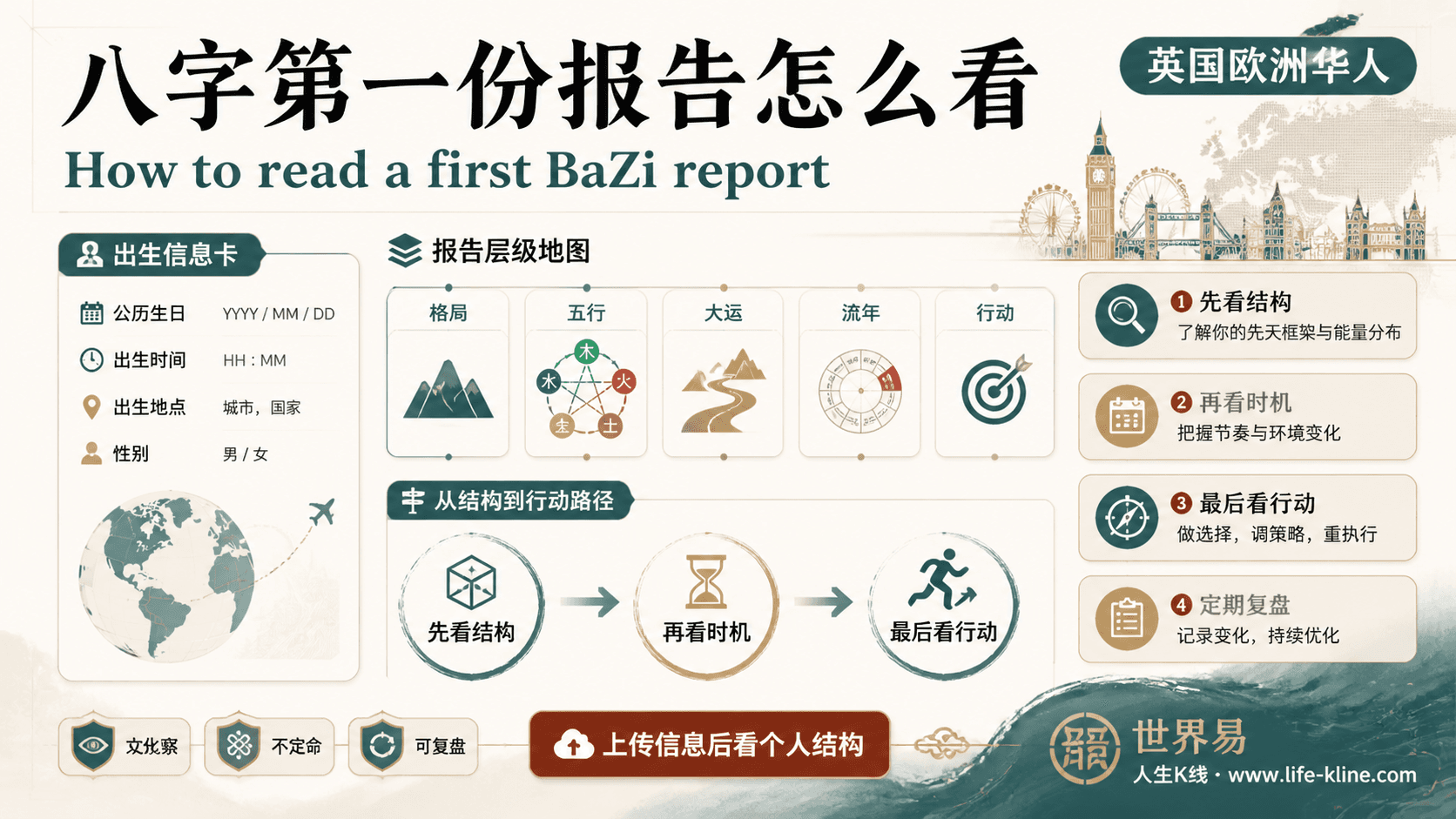
八字第一份报告怎么看|英国欧洲华人
这张图把《Bilingual Education Path Choices and Metaphysical Analysis for Chinese Families in the UK and Europe》里的命理概念转成关系、边界和应用场景,适合先看图建立结构,再回到知识文章正文理解细节。
八字第一份报告怎么看不应被写成固定结论。更适合英国欧洲华人的读法,是把传统术语翻译成结构、时机、环境、行动和复盘。
查看图片解读
