BaZi Analysis and Decision Guidance on Long-Term Growth Trajectories in Primary to Secondary School Transition School Selection
把这篇文章落到自己身上验证:先看结构,再进入个人分析,不做泛泛阅读。
你现在搜索的,
其实是一个要落到自己身上的判断。
当前页面主要回答「Educational Context」这类搜索问题;真正有价值的下一步是把这套结构带进自己的报告、工具与案例验证。
Why This Decision Is Especially Difficult at This Educational Stage
Selecting a school for the transition from primary to secondary education is not only a critical choice for the child's academic starting point but also an important node influencing their growth trajectory over the next decade. In the current Chinese education environment, parents face multiple options including public, private, and international schools, each accompanied by different school district policies, streaming mechanisms, and resource allocations, making the school selection decision extremely complex.
Moreover, under the 'Double Reduction' policy limiting extracurricular tutoring, the child's autonomous learning ability and expressive skills become key evaluation points. Parents often find themselves caught between the conflict of short-term scores and long-term ability cultivation. Interview preparation and the social environment of peer circles also become factors that cannot be ignored.
The intervention of BaZi structure at this stage provides parents with another dimension of reference. The strength of the Day Master, characteristics of the pattern, choice of Yong Shen, and changes in Da Yun and Liu Nian correspond to the child's learning status, expressive ability, and psychological rhythm, helping parents judge the truly suitable development path for the child's future.
However, BaZi judgment is not a single decisive factor but a comprehensive consideration combined with real education policies and family resources. Especially in China's current intense educational competition environment, rationally integrating BaZi rhythms with educational realities becomes key to decision-making.
Three Core Dimensions of BaZi Judgment
First, the strength of the Day Master determines the child's core temperament and self-motivation. A relatively strong Day Master often manifests as confidence and initiative, suitable for proactive learning and expression; a relatively weak Day Master requires support from the Yong Shen, emphasizing environmental and resource support to aid growth.
Second, Shi Shen (Food God) and Yin Xing (Seal Stars) are key Ten Gods influencing learning and expression. Shi Shen represents the child's creativity and expressive ability, while Yin Xing corresponds to learning absorption and internalization processes. Guan Sha (Officers and Seven Killings) relate to rules and pressure; if too strong, they may cause learning anxiety or suppression, if too weak, they may lack external constraints.
Finally, Da Yun and Liu Nian reflect the child's growth rhythm and environmental changes. When Da Yun is stable and compatible with the Yong Shen, the child is more likely to grow steadily; if there is conflict or punishment interaction between Liu Nian and Da Yun, it indicates the need for parents to adjust education strategies and timely guide or buffer pressure.
In the decision-making for primary to secondary school selection, understanding these three dimensions not only helps parents assess the child's current learning adaptability but also predicts future potential and risks, forming a scientific long-term education plan.
Three Real BaZi Chart Cases
Case 1: Male, Day Master Geng (庚, Metal), relatively strong, Zhuan Wang pattern (specialized strong pattern), Yong Shen Earth, Ji Shen Wood. Current Da Yun Ren Chen (壬辰) age 54-63, second year of Ren Chen Da Yun, Liu Nian Bing Wu (丙午). This chart shows a vigorous Day Master; the Zhuan Wang pattern indicates the child has strong self-motivation and execution ability. Earth as Yong Shen helps stabilize and accumulate resources, while Wood as Ji Shen means avoiding distractions. In school selection for the primary to secondary transition, it is suitable to choose a school environment that can leverage the child's concentration and stability, such as key public or high-quality private schools. The long-term growth trajectory suggests that the Zhuan Wang pattern performs well in stable environments; parents should avoid frequent changes in educational settings to ensure continuous resource investment. The judgment sequence recommendation: first check whether the Earth Yong Shen resource support is sufficient, then evaluate the environment's nourishment of the Geng Metal Day Master, and finally monitor Ji Shen Wood interference factors to adjust the school environment timely.
Case 2: Female, Day Master Gui (癸, Water), relatively weak, Bi Jian pattern (Peer competition pattern), Yong Shen Metal, Ji Shen Wood and Fire. Current Da Yun Ding Hai (丁亥) age 32-41, tenth year of Ding Hai Da Yun, Liu Nian Bing Wu (丙午). Gui Water is relatively weak and relies on Metal Yong Shen support. The Bi Jian pattern emphasizes peer competition and cooperation, while Ji Shen Wood and Fire represent excessive competition and pressure in the environment that may have negative effects. In school selection for the primary to secondary transition, it is advisable to choose schools that emphasize individual differences and teamwork, avoiding overly intense competitive environments; international or specialized private schools may be more appropriate. For the long-term growth trajectory, the chart suggests continuous attention to the child's emotional state and expressive ability to avoid learning burnout caused by excessive pressure. The judgment sequence recommendation: first confirm whether the Metal Yong Shen support is adequate, assess the competitive atmosphere of the school environment, and finally monitor pressure signals triggered by Ji Shen Wood and Fire to adjust the cultivation rhythm timely.
Case 3: Male, Day Master Bing (丙, Fire), relatively strong, Zheng Yin pattern (Proper Seal pattern), Yong Shen Fire, Ji Shen Wood. Current Da Yun Wu Chen (戊辰) age 21-30, seventh year of Wu Chen Da Yun, Liu Nian Bing Wu (丙午). Bing Fire is relatively strong; the Zheng Yin pattern indicates the child has strong learning absorption and internalization abilities. Yong Shen Fire further enhances creativity and expression, while Ji Shen Wood may cause energy dispersion. In school selection for the primary to secondary transition, it is suitable to choose schools with systematic teaching and encouragement for innovative expression, such as high-level international classes or specialized classes. In the long-term growth trajectory, the Zheng Yin pattern helps the child accumulate a solid knowledge foundation, but interference from Ji Shen Wood requires preventing interest dispersion. The judgment sequence recommendation: focus on whether the environment sufficiently cultivates the Fire Yong Shen, confirm if Ji Shen Wood interference is controllable, and finally judge the growth rhythm according to Da Yun and Liu Nian, planning the school selection timing reasonably.
Common Misjudgments and Blind Spots at This Stage
Many parents overly focus on short-term academic scores and school reputation during primary to secondary school selection, neglecting the potential strengths and weaknesses revealed by the child's BaZi structure, resulting in adaptation difficulties or loss of motivation in subsequent growth.
Another blind spot is ignoring the balance between Yong Shen and Ji Shen. Blindly pursuing personalized or international education may not suit children whose charts require stable environments and resource accumulation, which instead amplifies growth risks.
Additionally, the rhythm changes of Liu Nian and Da Yun are often overlooked by parents, who fail to adjust education strategies according to the child's growth cycle, missing critical support windows or lacking coping plans during pressure peaks.
Finally, BaZi is only a reference tool for growth trajectories. When facing psychological crises such as depression or self-harm, parents must promptly seek professional psychological assistance and avoid substituting BaZi judgment for scientific counseling.
Practical Judgment Sequence
Step one: Assess the child's Day Master strength and pattern type to clarify the child's core temperament and learning and expression preferences. This forms the basis for school selection and long-term planning.
Step two: Confirm whether the environment sufficiently supports the Yong Shen, including school educational resources, family support, and social environment, ensuring the child receives the energy needed for growth.
Step three: Identify potential negative impacts from the Ji Shen, especially environmental competition pressure, interest dispersion, or psychological burdens, and adjust education strategies timely to prevent risk amplification.
Step four: Combine the current Da Yun and Liu Nian rhythms to judge the child's growth stage focus, select suitable school selection timing and cultivation directions, balancing stability and breakthroughs, and avoid blind environment changes or excessive intervention.
FAQ
Question 1: How do the Yong Shen and Ji Shen in a child's BaZi chart affect school selection? Answer: Yong Shen represents the supportive elements needed for the child's growth. When selecting a school, priority should be given to environments that strengthen the Yong Shen. For example, if the Yong Shen is Earth, choosing a school with stable and resource-rich conditions is advisable. Ji Shen represents elements to avoid or control; the child should not be placed in environments where the Ji Shen is overly strong to prevent amplified growth risks.
Question 2: How to combine Da Yun and Liu Nian to judge the child's critical growth periods? Answer: Da Yun reflects the long-term growth rhythm, while Liu Nian indicates short-term environmental changes. When Da Yun and Liu Nian are harmonious, the child's growth is relatively stable and suitable for steady development. If there is obvious conflict, parents need to adjust education strategies, possibly requiring more care or flexibility.
Question 3: Can BaZi judgment replace professional psychological counseling? Answer: BaZi judgment is only a reference tool for growth rhythms and cannot replace professional psychological counseling. If the child experiences psychological crises such as depression or self-harm, parents should seek professional psychological assistance immediately to ensure the child's physical and mental health.

八字第一份报告怎么看|美国加拿大华人
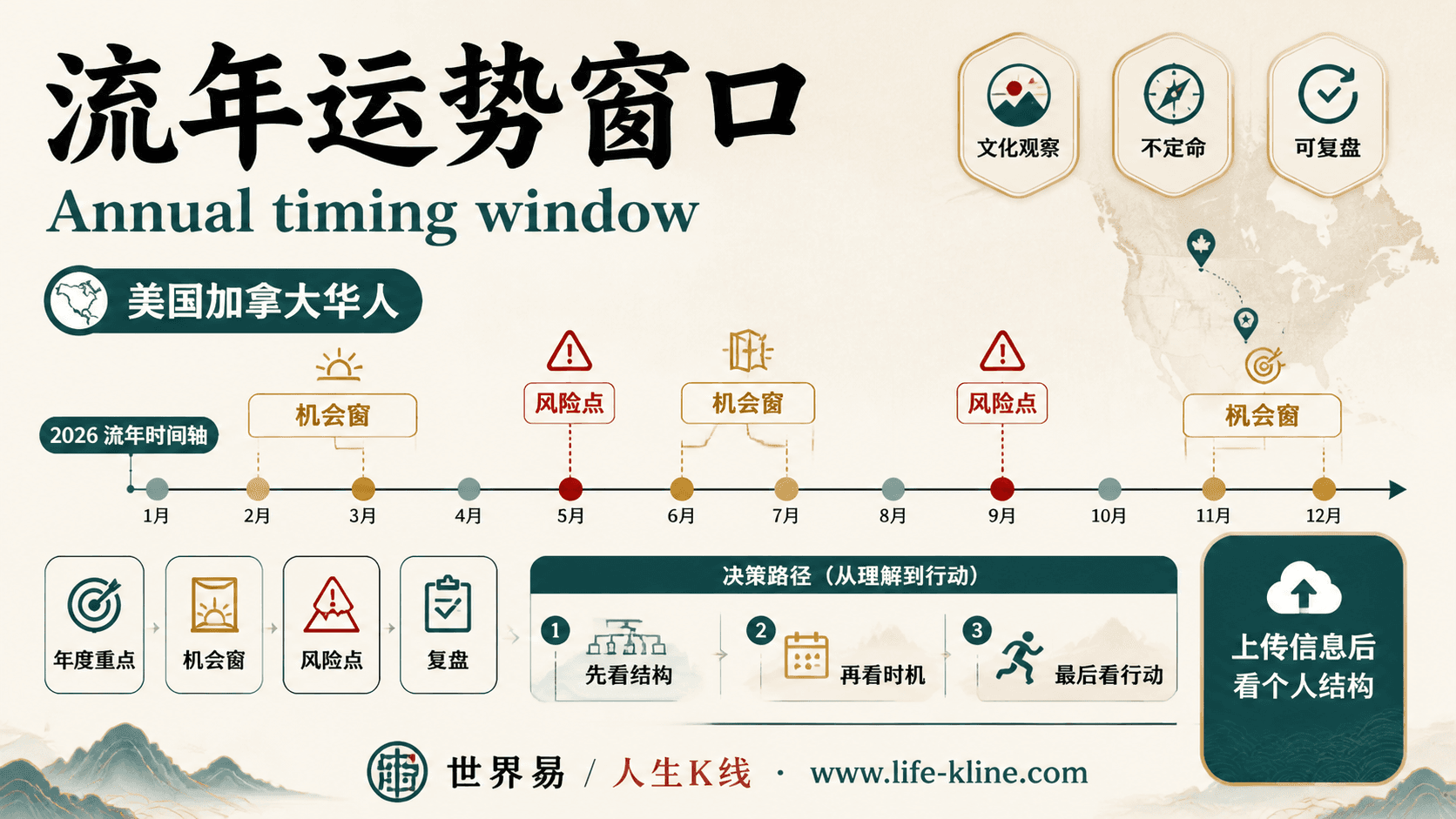
这张图把《BaZi Analysis and Decision Guidance on Long-Term Growth Trajectories in Primary to Secondary School Transition School Selection》里的命理概念转成关系、边界和应用场景,适合先看图建立结构,再回到知识文章正文理解细节。
八字第一份报告怎么看不应被写成固定结论。更适合美国加拿大华人的读法,是把传统术语翻译成结构、时机、环境、行动和复盘。
查看图片解读