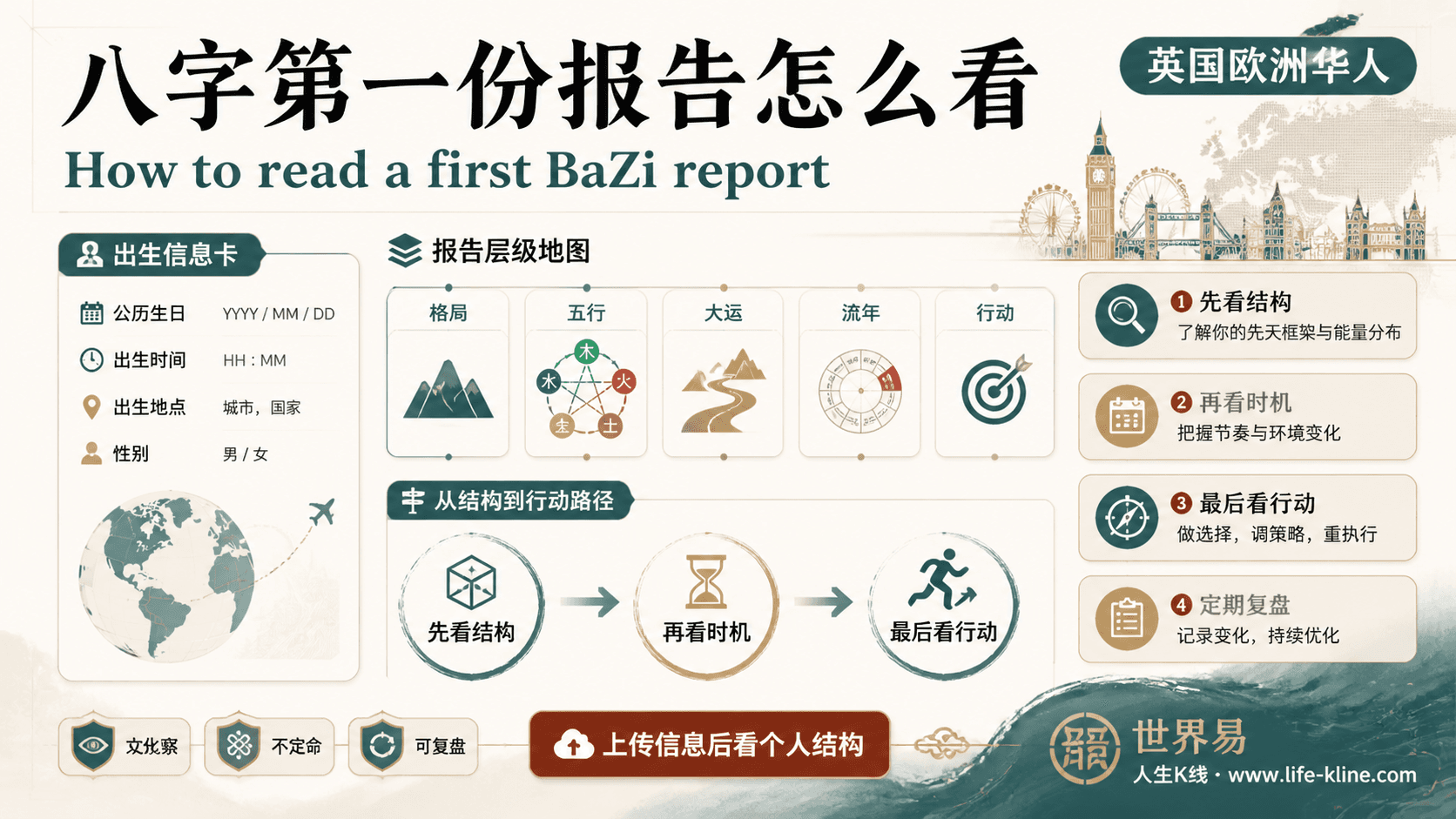
Analysis of Timing for Emotional and Psychological Stress Intervention: The Impact of Da Yun and Liu Nian on Health Decisions
把这篇文章落到自己身上验证:先看结构,再进入个人分析,不做泛泛阅读。
你现在搜索的,
其实是一个要落到自己身上的判断。
当前页面主要回答「Emotional Stress」这类搜索问题;真正有价值的下一步是把这套结构带进自己的报告、工具与案例验证。
Why This Decision Is Especially Difficult in This Health Scenario
Depressive tendencies, anxiety, panic, internal conflict, and somatization symptoms caused by emotional and psychological stress are often closely related to bodily rhythms and Zang-Fu organ functions. The intertwining of the patient's mental state and physical responses makes the judgment of intervention and medical timing particularly complex. For example, insomnia and extreme fatigue may mask underlying Zang-Fu imbalances, leading to delayed treatment.
The pace of life, intensity of stress, and the balance state of the Five Elements within the body mutually influence each other. When emotional fluctuations are intense, functions of the heart, liver, spleen, lungs, and kidneys change significantly, especially during Da Yun and Liu Nian Five Elements clashes or harmonies. The body's resistance and recovery abilities also fluctuate, increasing the difficulty of clinical intervention.
In BaZi structure, whether the Day Master is excessively strong or weak directly affects the Yin-Yang balance and the functions of the Zang-Fu organs. Particularly, the roles of Yong Shen (favorable element) and Ji Shen (unfavorable element) can exacerbate or alleviate mental stress and physical reactions at certain time nodes. This layering of fate rhythms becomes key to judging the success rate of surgery, regulation, or medication changes.
Therefore, accurately identifying the patient's current Five Elements and Zang-Fu status under the present Da Yun and Liu Nian environment, combined with actual symptoms, is essential to reasonably arrange intervention timing under emotional distress, avoiding dual physical and psychological burdens and enhancing treatment effectiveness and safety.
Correspondence Between BaZi and Five Elements Zang-Fu
In this scenario, the Day Master is mostly Fire, which corresponds to the heart and small intestine Zang-Fu organs, involving mental activity and blood circulation. When the Day Master is excessively strong, heart fire is overactive, easily causing palpitations, insomnia, anxiety, and other symptoms; when weak, heart Yang deficiency may manifest as mental fatigue, depression, and somatization.
The Yong Shen are mostly Water and Metal; Water governs the kidneys, Metal governs the lungs. Both relate to emotional regulation and Qi and blood circulation. When Water and Metal Yong Shen are weak, kidney Qi deficiency and unstable lung Qi may worsen physical frailty and anxiety. The Ji Shen is Wood, representing the liver, which governs dispersion and drainage. Liver Qi stagnation often leads to emotional depression and increased mental stress.
The current Liu Nian is Bing Wu (丙午, Bing Fire and Wu Fire), with dual Fire elements strongly active. Excessive heart fire easily intensifies emotional fluctuations, especially when Da Yun is weak or unfavorable, making the negative effects of excessive heart fire more pronounced. Conversely, auspicious Da Yun help balance heart and kidney, alleviating stress.
Therefore, integrating the Five Elements generating, overcoming, controlling, and transforming relationships in Da Yun and Liu Nian, with special attention to the interactions among Wood, Fire, Metal, and Water, is key to grasping the timing for emotional and psychological stress intervention. This alignment allows treatment and regulation to follow the body's rhythm and improves success rates.
Three Real BaZi Chart Cases
Case 1: This female's Day Master is Bing Fire (丙火), excessively strong, with a Shang Guan (伤官) pattern, favoring Water and Metal as Yong Shen, and Wood as Ji Shen. Currently in Yi Mao (乙卯) Da Yun (an unfavorable luck cycle requiring caution against major upheavals) combined with Bing Wu (丙午) Liu Nian, the strong Fire elements overlap, causing excessive heart fire and severe emotional fluctuations manifested as anxiety, insomnia, and internal conflict. The weak Da Yun and strong Liu Nian Fire impose a heavy cardiac burden. Intervention timing should avoid periods when Liu Nian and Da Yun Fire are both strong. It is recommended to observe whether the Water and Metal Yong Shen are effective; if Water and Metal are insufficient, surgery or medication changes should be approached cautiously. The judgment sequence suggests first assessing current kidney and lung functions (corresponding to Water and Metal), then combining with psychological stress intensity, and seeking immediate medical attention if necessary.
Case 2: This male's Day Master is Ding Fire (丁火), excessively strong, with a Pian Yin (偏印) pattern, favoring Water and Metal as Yong Shen, and Wood as Ji Shen. Currently in Ren Zi (壬子) Da Yun (a very auspicious cycle) combined with Bing Wu (丙午) Liu Nian, the Da Yun provides Water nourishment that helps regulate heart fire and relieve emotional stress. Although emotional fluctuations exist, overall Qi and blood circulation remain balanced, favorable for smooth intervention and recovery. Intervention timing can be chosen during the advantageous Da Yun period, combined with Liu Nian adjustments to enhance treatment success. The judgment sequence recommends confirming sufficient kidney Water and normal lung Metal function first, then dynamically adjusting treatment plans based on emotional state.
Case 3: This male's Day Master is Ding Fire (丁火), weak, with a Bi Jian (比肩) pattern, favoring Wood as Yong Shen and Earth and Metal as Ji Shen. Currently in Geng Chen (庚辰) Da Yun (an unfavorable cycle requiring caution against major upheavals) combined with Bing Wu (丙午) Liu Nian, although Fire is strong, the Day Master is weak, and Ji Shen Earth and Metal are exposed, damaging spleen, stomach, and lung functions. Emotional internal conflict, anxiety, and somatization symptoms are prominent. The weak and unfavorable Da Yun combined with strong Liu Nian Fire further aggravates internal Yin-Yang imbalance. Intervention timing should be highly cautious, avoiding surgery or medication changes before the unfavorable Da Yun passes. The judgment sequence suggests first ruling out spleen, stomach, and lung dysfunction, observing emotional fluctuations and physical weakness, and seeking immediate medical attention if severe.
Common Misjudgments and Blind Spots in This Scenario
Intervention decisions for emotional and psychological stress are often misjudged as purely mental issues, neglecting the intrinsic rhythms of the Five Elements and Zang-Fu organs, resulting in poor treatment outcomes or recurring conditions. Especially during Da Yun and Liu Nian with strong Fire, excessive heart fire is easily overlooked, and the underlying cardiac burden is not promptly identified.
Some practitioners misuse BaZi as a medical diagnostic tool, ignoring its role as an auxiliary rhythm reference, thereby delaying critical emergency treatment. When severe emotional fluctuations accompany somatic symptoms, patients must be explicitly advised to seek immediate medical care to avoid blind waiting caused by BaZi judgments.
Another misconception is over-reliance on Da Yun auspiciousness or inauspiciousness, neglecting the direct impact of specific Yong Shen, Ji Shen, and Five Elements excess or deficiency on the body. Only by combining Day Master strength, Yong Shen regulation, and Zang-Fu correspondence can intervention timing be scientifically analyzed, rather than simple auspicious or inauspicious judgments.
Therefore, BaZi should serve as a rhythm reference for emotional and physical health to assist clinical decisions, not replace medical diagnosis, avoiding misjudgment and treatment delays.
Practical Judgment Sequence
Step 1: Confirm the severity of the patient's current emotional and somatic symptoms. If there are obvious red flags such as palpitations, breathing difficulties, persistent insomnia, or mental breakdown, seek immediate medical care. BaZi serves only as a rhythm reference and should not delay treatment.
Step 2: Combine the BaZi chart's Day Master strength, Yong Shen, and Ji Shen, with particular attention to the Five Elements changes in the current Da Yun and Liu Nian. Assess the functional state of the five Zang organs—heart, kidneys, lungs, liver, and spleen—to evaluate the internal rhythm of body and mind, assisting in judging safe intervention windows.
Step 3: During auspicious Da Yun and Liu Nian with effective Yong Shen, the patient's physical recovery is stronger, suitable for surgery or medication adjustments. Conversely, during weak or unfavorable Da Yun and Liu Nian with Ji Shen exposure, prioritize non-invasive regulation measures, closely monitor symptom changes, and avoid aggressive interventions.
Overall judgments should dynamically integrate the patient's actual condition with BaZi rhythms to ensure intervention timing aligns with bodily rhythms, maximizing treatment effectiveness and safety.
FAQ
Question 1: If emotional distress is severe but BaZi shows an auspicious Da Yun, can medical treatment be delayed? Answer: BaZi is only a rhythm reference. If severe emotional breakdown or physical discomfort occurs, seek immediate medical care. Do not rely on auspicious Da Yun to postpone treatment.
Question 2: How to determine the best timing for emotional regulation through Five Elements Yong Shen? Answer: Observe whether the Yong Shen, especially Water and Metal, are strong and balanced. If Yong Shen is vigorous and Da Yun is auspicious, regulation is more effective and suitable for intervention.
Question 3: Can BaZi replace psychological counseling and medical diagnosis? Answer: No. BaZi serves only as an auxiliary reference and cannot replace professional medical diagnosis or psychological therapy. In emergencies, seek timely medical attention.

木过旺与再平衡
这张图把《Analysis of Timing for Emotional and Psychological Stress Intervention: The Impact of Da Yun and Liu Nian on Health Decisions》里的命理概念转成关系、边界和应用场景,适合先看图建立结构,再回到知识文章正文理解细节。
木过旺常表现为扩张过快、计划繁多、方向分散。在人生K线系统中,这是一种时位特征,而非固定标签。通过引入边界、沉淀与复盘,可实现自然再平衡,导向更可持续的结构。
查看图片解读