BaZi Analysis and Practical Guide for Health Recovery of Australian and New Zealand Chinese after Migration
把这篇文章落到自己身上验证:先看结构,再进入个人分析,不做泛泛阅读。
Why This Scenario Is Especially Difficult for Overseas Chinese
Australian and New Zealand Chinese face climate changes caused by latitude differences, dietary structure adjustments, and lifestyle transformations during migration. These practical constraints directly affect the body's functional adaptation and recovery. The Southern Hemisphere’s seasons differ drastically from the Northern Hemisphere’s, especially in temperature and humidity changes, which easily cause fluctuations in immunity, leading to chronic fatigue, indigestion, and other health issues.
Cultural differences are particularly prominent in health management. The medical systems in Australia and New Zealand differ from traditional Chinese medicine concepts. Overseas Chinese often encounter communication barriers and conflicting treatment philosophies when seeking medical help, complicating the health recovery process. From a metaphysical standpoint, changes in climate and environment are analogous to shifts in palace environments, which can amplify or suppress the manifestation of the Yong Shen in the BaZi chart, thereby affecting health status.
The combination of BaZi structure and environmental factors makes it difficult to timely and accurately identify health signals. Especially, the Yong Shen and Ji Shen (unfavorable element) are influenced differently by varying climates and diets. The interaction between the BaZi’s Da Yun and Liu Nian and real-life rhythms determines the timing and difficulty of health recovery. Accurately capturing the body’s warning signals becomes the core challenge in health management for overseas Chinese after migration.
Additionally, limited resources and time investment due to cross-border family distances, taxation, and lack of social support systems increase reliance on metaphysical tools. Precise BaZi analysis can effectively identify critical nodes in health recovery, avoiding blind actions and resource waste.
Three Core Dimensions of Metaphysical Judgment
The primary dimension is the Day Master and pattern. The Day Master represents the fundamental personal energy, while the pattern reveals the overall structure and operational mode of the BaZi chart. For health recovery of Australian and New Zealand Chinese, the strength of the Day Master determines basic physical resistance and recovery capacity; the pattern reflects dominant bodily functions and potential health risks.
The second dimension is Yong Shen (favorable element) and Ji Shen (unfavorable element). Yong Shen is the key element in the BaZi chart that harmonizes the Day Master and promotes health recovery, whereas Ji Shen negatively affects health. Different climates and dietary environments after migration can amplify the influence of Yong Shen or Ji Shen. For example, a humid and hot environment may trigger negative effects of Ji Shen Earth, causing digestive system problems.
The third dimension is Da Yun (decade luck cycle) and Liu Nian (annual fortune). Da Yun represents long-term fortune trends, while Liu Nian reflects specific environmental impacts of the year. Their interaction determines the timing and difficulties of health recovery. For instance, when Da Yun is weak, one should act cautiously to avoid overexertion and environmental stress; a favorable Liu Nian supports bodily repair and adjustment.
Lastly, although palace environments are not directly listed, they can be likened to real-life environmental factors that assist or constrain metaphysical influences. The geographical location, social environment, and medical resources available to Australian and New Zealand Chinese are external conditions that must be considered in BaZi judgment.
Three Real BaZi Chart Cases
Case 1: Female, aged 45-50, Day Master 癸水 (Gui Water), balanced, Shi Shen (Eating God) pattern, Yong Shen Fire, Ji Shen Earth, currently in Ji (己, Ji) Mao (卯, Mao) Da Yun (weak), and Bing (丙, Bing) Wu (午, Wu) Liu Nian. After migration to Australia and New Zealand, Fire as Yong Shen is affected by the weak Da Yun, making her susceptible to cold and damp-related bodily issues. The humid environment increases the burden of Ji Shen Earth, leading to digestive and metabolic decline. It is recommended to prioritize monitoring signs of cold-heat imbalance, adjust diet reasonably, enhance Yang energy, and activate Fire energy through traditional Chinese medicine or exercise while avoiding Earth accumulation. The judgment sequence should first check the body’s adaptation to climate, then observe digestive and immune indicators, and finally adjust lifestyle rhythms.
Case 2: Male, aged 25-30, Day Master 丁火 (Ding Fire), relatively strong, Yang Ren (Yang Blade) pattern, Yong Shen Earth, Ji Shen Wood, currently in Xin (辛, Xin) Mao (卯, Mao) Da Yun (stable), and Bing (丙, Bing) Wu (午, Wu) Liu Nian. The strong Fire Day Master requires Earth to nurture and support; Yong Shen Earth helps stabilize health. The Australian and New Zealand climate benefits Fire-strong constitutions, but when Ji Shen Wood is strong, it may cause liver, gallbladder, and nervous system tension. The migration-induced high-protein and high-fat diet requires caution regarding liver burden. It is advised to focus on mental state and liver-gallbladder function signals, arrange rest and work reasonably, and perform liver and spleen nourishing adjustments timely. The judgment sequence should first confirm mental and emotional fluctuations, then monitor liver and gallbladder signs, and finally assess dietary adjustment effects.
Case 3: Female, aged 30-35, Day Master 戊土 (Wu Earth), relatively strong, Qi Sha (Seven Killings) pattern, Yong Shen Wood and Water, Ji Shen Fire, currently in Xin (辛, Xin) Mao (卯, Mao) Da Yun (auspicious), and Bing (丙, Bing) Wu (午, Wu) Liu Nian. The Yong Shen Wood and Water help balance the strong Wu Earth Day Master, while Ji Shen Fire is significantly influenced by environmental heat. The relatively mild climate of Australia and New Zealand benefits Wood and Water Yong Shen, but high-calorie diets may activate Ji Shen Fire, causing inflammation and internal heat. The body’s self-repair ability is strong post-migration, but the negative effects of Fire should be watched. It is recommended to prioritize monitoring inflammation and sleep quality, suppress Fire energy by adjusting diet and lifestyle. The judgment sequence involves observing heat symptoms, evaluating sleep and mental state, and finally adjusting Yong Shen remedies based on recovery status.
Common Misconceptions of Overseas Chinese in This Scenario
Many overseas Chinese overlook the profound impact of climate and dietary changes after migration, simply applying health management experiences from their original residence, resulting in failure to timely detect warning signals during the adaptation period. Additionally, mistaking the strength of the Day Master as the sole criterion for health recovery ignores the dynamic balance between Yong Shen and Ji Shen, leading to ineffective treatment plans.
Another misconception is neglecting the guiding significance of Da Yun and Liu Nian on health rhythms. Many act aggressively during weak Da Yun or unfavorable Liu Nian periods, ignoring caution and rest, which exacerbates bodily burdens. Some also respond slowly to bodily signals, failing to adjust lifestyle and treatment promptly, delaying recovery.
Cultural differences causing underutilization of medical resources is also common. Some overseas Chinese hesitate to seek professional medical help due to language barriers or cultural gaps, relying on traditional remedies or self-diagnosis, neglecting the influence of metaphysical environmental factors on health, thereby prolonging recovery.
Finally, overreliance on a single metaphysical factor while ignoring the compound effects of real environmental changes is a fatal flaw in health recovery judgment. It is essential to integrate BaZi analysis with actual life conditions to scientifically formulate health management strategies.
Practical Judgment Sequence
First, combine the Day Master and Yong Shen to assess the body’s basic energy state and primary health risks, confirming the initial response to climate and dietary changes after migration. This stage focuses on observing signals such as temperature regulation, digestive function, and mental state, adjusting lifestyle and diet promptly.
Second, based on the current Da Yun and Liu Nian, judge the timing and risk points of health recovery. When Da Yun is weak, act cautiously, avoiding intense exercise and environmental stress; when Liu Nian is favorable, moderate proactive adjustments are appropriate. Dynamically monitor bodily changes to determine the optimal window for action and rest.
Finally, integrate real-life environment and family support systems to develop specific health management plans. Make reasonable use of local medical resources, coordinate psychological support across borders, and formulate preventive and responsive measures addressing potential Ji Shen risks. Through dual verification of metaphysics and reality, ensure scientific and sustainable health recovery.
FAQ
Question 1: After migration, which bodily signals deserve the most attention? Answer: Focus primarily on abnormal body temperature, digestive dysfunction, mental state fluctuations, and decreased immunity. These reflect the body’s adaptation to climate, diet, and living environment, serving as important indicators for judging health recovery progress.
Question 2: How to combine BaZi to judge the timing of health recovery after migration? Answer: Reference the current Da Yun and Liu Nian, especially the strength of Da Yun and the auspiciousness of Liu Nian, to judge the trend of bodily energy recovery. Exercise caution during weak Da Yun periods to avoid intense actions; during favorable Liu Nian, actively adjust lifestyle and treatment plans.
Question 3: Under Australian and New Zealand environments, which metaphysical factors are easily amplified by climate and diet? Answer: Yong Shen and Ji Shen are particularly critical. For example, humid climates may increase the burden of Ji Shen Earth, causing digestive problems; high-calorie diets may activate Ji Shen Fire, leading to internal heat and inflammation. It is necessary to adjust scientifically according to the specific BaZi chart.

八字第一份报告怎么看|美国加拿大华人
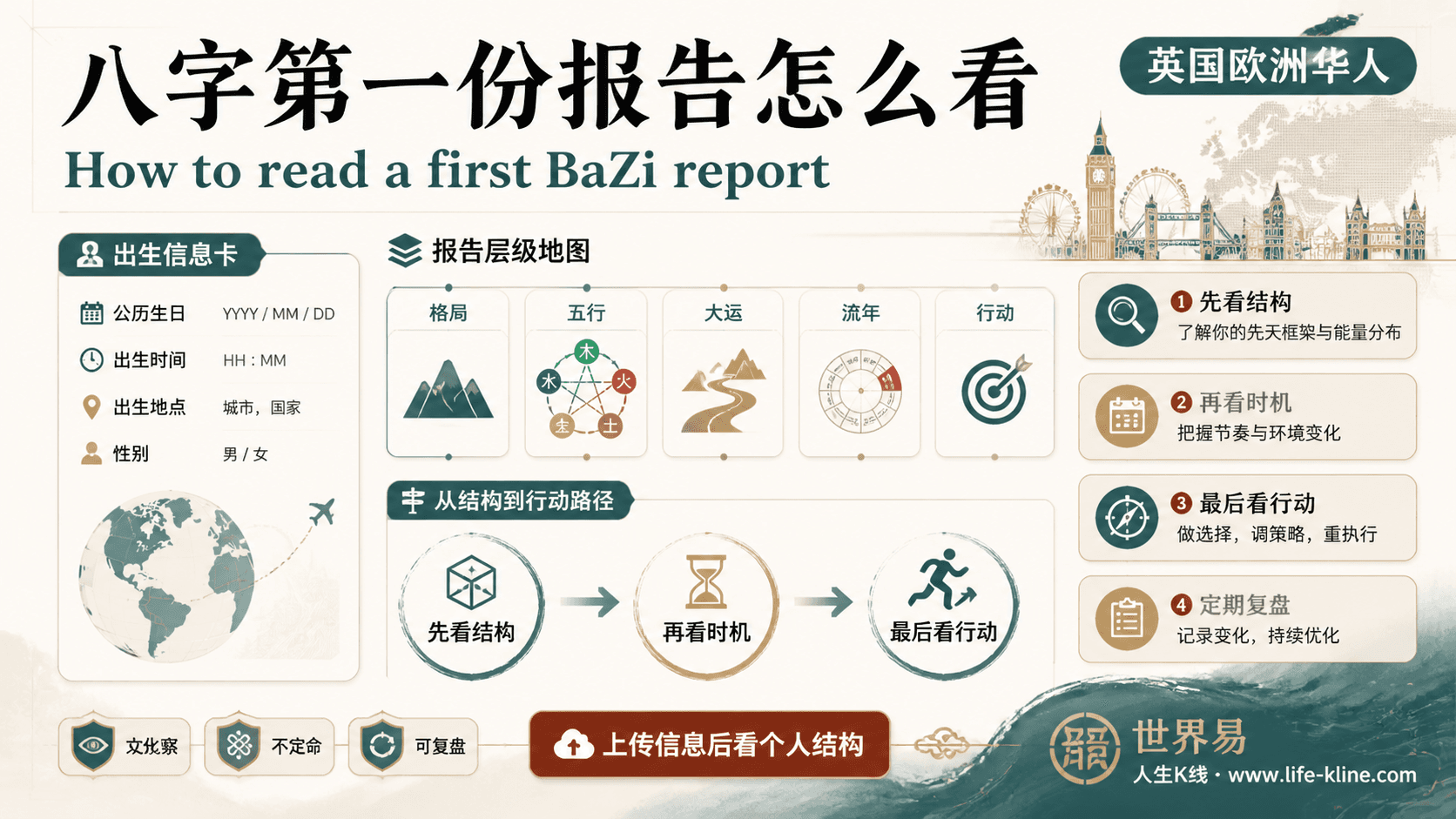
这张图把《BaZi Analysis and Practical Guide for Health Recovery of Australian and New Zealand Chinese after Migration》里的命理概念转成关系、边界和应用场景,适合先看图建立结构,再回到知识文章正文理解细节。
八字第一份报告怎么看不应被写成固定结论。更适合美国加拿大华人的读法,是把传统术语翻译成结构、时机、环境、行动和复盘。
查看图片解读