Astrological and Practical Analysis of Overseas Chinese in Australia and New Zealand Caring for Elderly Parents
把这篇文章落到自己身上验证:先看结构,再进入个人分析,不做泛泛阅读。
Why This Scenario Is Especially Difficult for Overseas Chinese
Overseas Chinese in Australia and New Zealand face dual challenges of geographic distance and cultural differences when deciding how to care for elderly parents. On one hand, aging parents require daily care; on the other, individuals live abroad under heavy work pressure, with economic burdens from tax and exchange rate fluctuations. These practical constraints make caregiving decisions extremely complex.
Culturally, traditional Chinese values emphasize filial piety, viewing personal accompaniment as a duty and responsibility; however, Australian and New Zealand societies emphasize individual independence and legal regulations. Issues such as long-term cross-border residency, healthcare coverage, and tax reporting must be considered, significantly increasing the cost and risk of returning home to provide care.
From an astrological perspective, the strength of the Day Master, the BaZi pattern, and the Yong Shen (favorable element) reveal the flow and balance of personal energy, reflecting the individual's ability to allocate family responsibilities and personal resources. Da Yun (decade luck cycles) and Liu Nian (annual fortune) correspond to fluctuations in luck over time, indicating whether the timing of decisions is favorable.
When the real-world environment and astrological structure overlap, certain energies in the BaZi chart are amplified or suppressed, affecting risk assessment and decisiveness. Especially in cross-border living, harmonizing astrological factors with practical compromises is key to sound judgment.
Three Core Dimensions of Astrological Judgment
First is the Day Master and the overall pattern. The Day Master represents the core personal strength; its strength or weakness sets the tone for facing external challenges. The pattern reflects the overall energy combination in the BaZi chart. For example, Pian Cai (偏财) pattern and Qi Sha (七杀) pattern correspond to different resource and pressure characteristics, influencing resource allocation and risk tolerance in decision-making.
Second is the Yong Shen (favorable element). Yong Shen is the key element for astrological harmonization, indicating which Five Element energy should be emphasized or supplemented. For instance, Wood Yong Shen represents growth and support; Metal Yong Shen emphasizes rules and execution; Earth Yong Shen embodies stability and bearing capacity. The relationship of Yong Shen determines the psychological and behavioral direction during decision-making.
Lastly, attention is paid to Da Yun (ten-year luck cycles) and Liu Nian (annual fortune). Da Yun represents decade-long trends, while Liu Nian reflects the specific energy of the current year. Their interaction reveals the auspiciousness of timing, whether to maintain the status quo, adapt flexibly, or actively advance. Especially in cross-border caregiving, timing directly affects resource allocation and family harmony.
Additionally, although palace environments (house sectors) are not detailed here, in reality, astrological reflections of family, career, and health must be considered alongside social environment factors to form a comprehensive decision-making framework.
Three Real BaZi Chart Case Studies
Case 1: Female, aged 55-60, Day Master Bing Fire (丙火) slightly weak, pattern is Pian Cai (偏财) pattern, Yong Shen is Wood, Da Yun is Jia Xu (甲戌) covering ages 51-60, current Liu Nian is Bing Wu (丙午). Although Bing Fire is somewhat weak, the Pian Cai pattern indicates a certain ability to allocate resources. Wood Yong Shen emphasizes growth and support. In the Australia-New Zealand context, this woman faces economic stability but strong emotional support needs. The overseas distance and cultural gap make physical accompaniment difficult, but the steady Da Yun suggests it is suitable to maintain the status quo, while the flexible Liu Nian indicates adapting as needed. This suggests she can mainly provide remote support while arranging timely visits home to balance emotional and practical needs. The recommended judgment sequence is to first assess the economic and emotional capacity for remote support, then adjust the timing of home visits according to Da Yun and Liu Nian.
Case 2: Male, aged 40-45, Day Master Gui Water (癸水) slightly weak, pattern is Qi Sha (七杀) pattern, Yong Shen is Metal, Da Yun is Yi You (乙酉) covering ages 32-41, current Liu Nian is Bing Wu (丙午). The Qi Sha pattern carries challenges and pressure, and the weak Gui Water Day Master indicates limited capacity to withstand external environments. Metal Yong Shen emphasizes rules and execution, suitable for rational planning. In the Australia-New Zealand reality, this man may face work pressure and complex cross-border taxation, making frequent trips home difficult. The steady Da Yun suggests maintaining the status quo, and the flexible Liu Nian implies adapting as necessary. This means he is suited for a stable remote support strategy, possibly institutionalizing caregiving responsibilities by hiring professionals or enlisting relatives' help. The judgment sequence recommends clarifying financial and legal boundaries first, then establishing a stable remote caregiving system to avoid frequent changes.
Case 3: Female, aged 55-60, Day Master Gui Water (癸水) slightly strong, pattern is Pian Cai (偏财) pattern, Yong Shen is Earth and Fire, Da Yun is Xin Si (辛巳) covering ages 51-60, current Liu Nian is Bing Wu (丙午). The slightly strong Gui Water Day Master indicates strong emotional and adaptability capacity, and the Pian Cai pattern shows relatively abundant resources. Earth and Fire Yong Shen emphasize stability and action. In the Australia-New Zealand environment, this woman has strong resources and ability to flexibly allocate time and energy between overseas and domestic life. The stable Da Yun and flexible Liu Nian suggest she can consider more proactive arrangements for returning home to care, while balancing overseas life and economic stability. The judgment sequence recommends assessing the match between her own health and parents' needs, planning time and financial budgets reasonably to ensure caregiving quality and personal life balance.
Common Misconceptions Among Overseas Chinese in This Scenario
Many overseas Chinese in Australia and New Zealand, when facing elderly parent care, tend to fall into emotional extremes of "all return home" or "completely remote care," neglecting the economic, legal, and time costs of reality, resulting in unbalanced decisions. Astrological indications from Yong Shen and Da Yun are often ignored, missing more reasonable action windows.
Additionally, some mistakenly believe BaZi only determines an unchangeable fate, ignoring the adaptive nature of Da Yun and Liu Nian, making it difficult to flexibly adjust caregiving strategies. This rigid mindset conflicts with the dynamic changes of real environments, increasing decision risks.
Another common misconception is overlooking the impact of cross-border taxation, medical insurance, and exchange rate fluctuations, leading to overestimation of available funds and resources. The suppressive effect of Ji Shen (unfavorable elements) in BaZi often corresponds to external environmental obstacles in reality, which need early identification and avoidance.
Finally, many neglect the capacity corresponding to their Day Master strength and pattern, blindly taking on excessive caregiving responsibilities, easily causing physical and mental exhaustion. Combining astrological and practical perspectives can help avoid such pitfalls and achieve sustainable family support.
Practical Judgment Sequence
Step one is to clarify one’s Day Master strength and Yong Shen needs, combined with the current energy trends of Da Yun and Liu Nian, to judge personal capacity and action ability. If the Day Master is weak and Yong Shen is suppressed, priority should be given to remote support to avoid overexertion.
Step two is to assess practical constraints, including tax policies, cross-border medical support, exchange rate risks, and family member distribution. Identify real-world pressure points corresponding to Ji Shen, and reasonably plan financial and time budgets to ensure decision feasibility and stability.
Step three is to combine BaZi’s Liu Nian and Da Yun to select timing. When Da Yun is stable and favors maintaining status quo, prioritize consolidating existing support systems; when Liu Nian indicates flexibility, adjust strategies accordingly, such as timely home visits or modifying caregiving methods. Overall judgment should be dynamically tracked to avoid fixed thinking.
FAQ
Question 1: How do overseas distance and cultural differences affect the practical use of BaZi judgment? Answer: BaZi reflects personal energy and trends, while distance and cultural differences represent external environmental specifics. When combined, BaZi’s influence is amplified or suppressed, enhancing practical usefulness. For example, when Yong Shen is obstructed, real obstacles are often more pronounced, requiring extra caution in decision-making.
Question 2: How do Da Yun and Liu Nian specifically guide caregiving timing decisions? Answer: Da Yun represents long-term trends, while Liu Nian reflects the year’s specific energy. Stable Da Yun favors maintaining or steady progress, while Liu Nian’s flexibility signals the need to adapt strategies. Combining BaZi judgment, one can choose auspicious Liu Nian years for home visits or strengthening remote support, avoiding impulsive decisions.
Question 3: How can BaZi help avoid emotional decision-making in caregiving? Answer: BaZi reveals inner energy structures through the Day Master and Yong Shen, providing objective judgment bases. Combined with practical constraints, it forms a rational framework that helps reduce emotional interference. Practically, it is recommended to first conduct BaZi analysis alongside reality assessment, then develop phased execution plans to minimize emotional impulsiveness.

八字第一份报告怎么看|澳新西兰华人
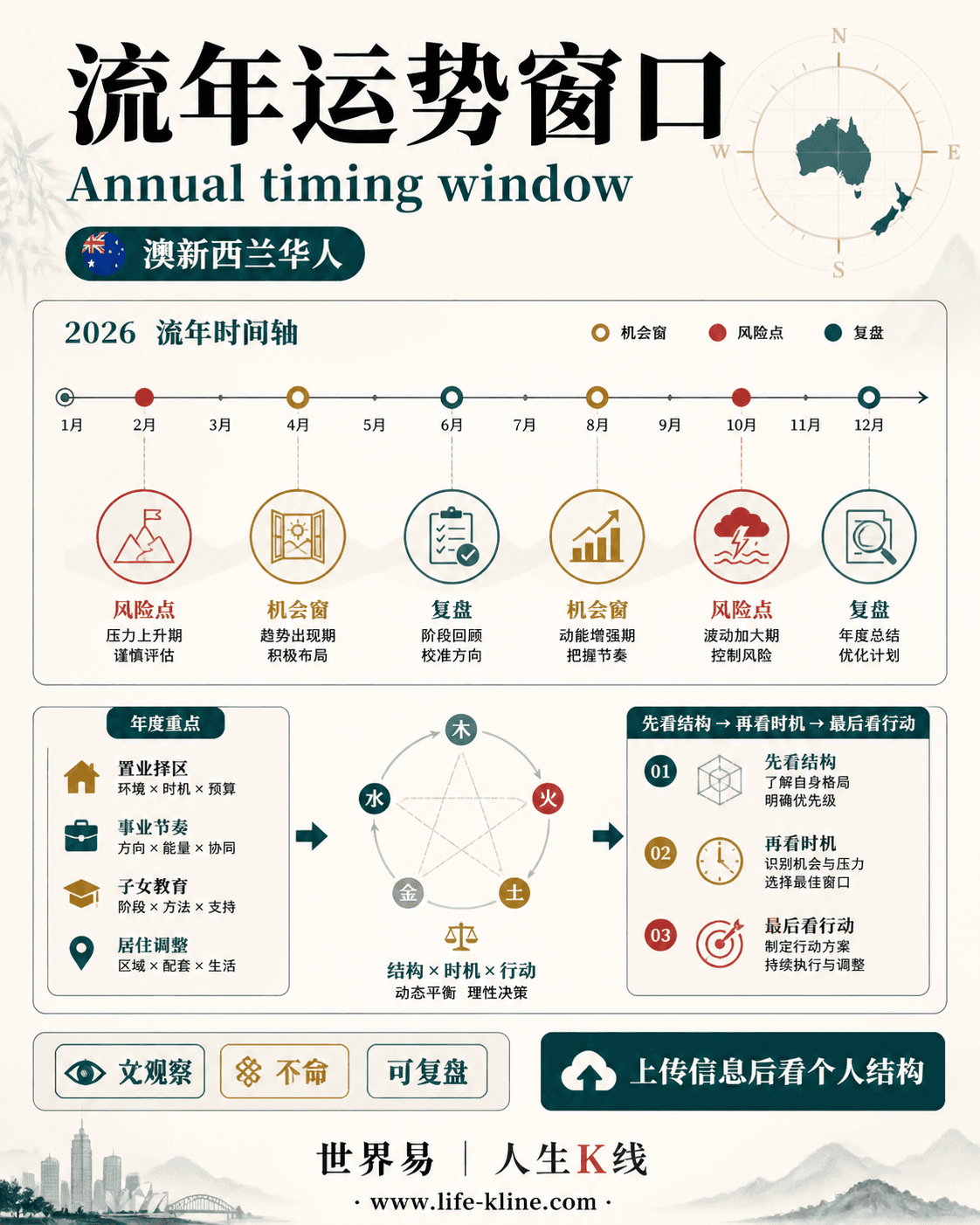
这张图把《Astrological and Practical Analysis of Overseas Chinese in Australia and New Zealand Caring for Elderly Parents》里的命理概念转成关系、边界和应用场景,适合先看图建立结构,再回到知识文章正文理解细节。
八字第一份报告怎么看不应被写成固定结论。更适合澳新西兰华人的读法,是把传统术语翻译成结构、时机、环境、行动和复盘。
查看图片解读