Analysis of the Best Timing for Family Communication When Adult Children Delay Independence and Metaphysical Guidance
把这篇文章落到自己身上验证:先看结构,再进入个人分析,不做泛泛阅读。
Why This Decision Is Especially Difficult in This Scenario
When adult children delay independence, manifested as economic dependence on parents, remaining unmarried, or postponing autonomy, the family’s economic symbiotic relationship often becomes tense. On one hand, parents expect their children to grow independently; on the other hand, they worry about the risks of premature separation, leading to increased anxiety and controlling tendencies. At this time, the attachment between parents and children conflicts with the children’s need for autonomy development, making communication prone to emotional and confrontational patterns.
From the perspective of parenting dynamics, parents’ intergenerational expectations and educational pressures often intensify behavioral interventions on adult children, especially regarding financial support. Weak autonomy in adult children may cause resistance to parents’ rule adjustments, creating a vicious cycle of interaction and greatly increasing the probability of communication failure.
From the metaphysical angle, the Da Yun and Liu Nian rhythms in the BaZi chart of children who delay independence significantly influence their behavioral states and emotional fluctuations. Particularly, the strength or weakness of the child’s Day Master, the prosperity or decline of the Yong Shen, and the clash or combination relationships between the current Da Yun and Liu Nian all amplify or suppress their willingness to accept positive parental communication.
Therefore, when parents decide when to initiate rule adjustments and critical communication, they must comprehensively consider parenting psychological dynamics and metaphysical rhythms. Avoiding hasty actions or prolonged waiting can improve the success rate and actual effectiveness of communication.
Three Core Dimensions of Metaphysical Judgment
First, the strength of the child’s Day Master and the overall BaZi pattern are fundamental. Children with a relatively weak Day Master (e.g., Xin Wei Day Master weak) may rely more on external support for autonomy development and particularly need the fire Yong Shen to stimulate motivation. Conversely, children with a relatively strong Day Master (e.g., Xin Chou, Ji Wei Day Master strong) have stronger autonomy awareness, but if the Yong Shen is restricted by the Ji Shen (unfavorable element), emotional volatility and communication resistance can also intensify.
Second, the Yin star (Pian Yin/Zheng Yin) represents attachment and inner security. A strong Yin star indicates greater dependence on parents, often manifesting emotional needs during communication. Parents need to guide cautiously to avoid excessive control. The Bi Jian (Peer star) and Shi Shen (Eating God) stars relate to autonomy and expression; when prosperous, they favor awakening the child’s self-awareness. Communication should respect and provide space accordingly.
Third, the Guan Sha stars (Zheng Guan/Qi Sha) reflect authority and rules. Parents’ authoritative role in communication is influenced by the strength of these stars. When Guan Sha is strong and restrains the Day Master, children may show rebellious emotions. Communication should avoid one-way commands and seek mutual understanding. The clash and combination relationships of Liu Nian and Da Yun indicate the risks and opportunities in the current rhythm; for example, it is advisable to maintain stability during steady Da Yun, while Liu Nian clashes suggest windows for adjustment.
In summary, judging when to carry out critical communication requires integrating the prosperity or decline of the Day Master’s Yong Shen, the attachment state indicated by the Yin star, the authoritative atmosphere from Guan Sha stars, and the rhythms of Da Yun and Liu Nian to find a practical and effective action point.
Three Real BaZi Chart Cases
Case 1: Male child, aged 50-55, Day Master Xin (Metal) relatively weak, pattern is Pian Cai (Indirect Wealth), Yong Shen is Fire, Ji Shen are Water and Wood. Currently in the 9th year of Geng Chen Da Yun, a stable Da Yun suitable for maintaining status quo; Liu Nian is Bing Wu, indicating adaptability. In this chart, the Day Master is weak and requires Fire Yong Shen to stimulate motivation. Parents should pay attention to the child’s dependency psychology during communication and avoid triggering emotions related to Water and Wood Ji Shen. The stable Geng Chen Da Yun suggests gentle rule adjustments at this stage, while the Bing Wu Liu Nian provides a temporary opportunity for change. It is suitable to initiate positive communication when the child shows slight proactive signals. The recommended judgment sequence is to first observe the child’s active Fire element behavior, then combine with Liu Nian dynamics to gradually adjust support and independence rules, alongside professional psychological counseling support.
Case 2: Male child, aged 25-30, Day Master Xin (Metal) relatively strong, pattern is Shang Guan (Hurting Officer), Yong Shen is Water, Ji Shen is Earth. Currently in the 5th year of Ji Si Da Yun, also a period for maintaining status quo; Liu Nian is Bing Wu, indicating adaptability. A strong Day Master with Shang Guan pattern means the child has strong autonomy and active emotional expression but is restricted by Ji Shen Earth, limiting action. Parents should avoid applying harsh Earth-like pressure during communication and use gentle Water element methods to guide the child’s self-reflection. The combination of a stable Da Yun and adaptable Liu Nian suggests a flexible communication window, suitable for rule adjustments when the child’s emotions are stable and they express themselves proactively. The judgment sequence is to focus on the strength of the child’s Water element emotional expression, consider the steady Da Yun characteristics, choose non-confrontational communication strategies, and supplement with family therapy if necessary to alleviate intergenerational conflicts.
Case 3: Male child, aged 35-40, Day Master Ji (Earth) relatively strong, pattern is Jie Cai (Rob Wealth), Yong Shen are Wood and Water, Ji Shen is Fire. Currently in the 4th year of Jia Wu Da Yun, a period for maintaining status quo; Liu Nian is Bing Wu, indicating adaptability. A strong Day Master with Jie Cai pattern shows the child has a strong sense of autonomy and a tendency to compete for resources. Wood and Water Yong Shen are needed for balance, while Fire Ji Shen aggravates conflicts. Parents should avoid fiery, intense emotions during communication and focus on nourishing with Wood and Water elements to promote understanding and intimacy. The stable Da Yun combined with Wu Fire Liu Nian reminds parents to control emotions during communication. The judgment sequence suggests first assessing whether the child’s emotional Fire energy is high, then applying Wood and Water nourishing strategies to choose an appropriate time for rule adjustment, while coordinating psychological counseling to prevent escalation.
Common Misjudgments and Blind Spots in This Scenario
First, over-reliance on metaphysical rhythms can mechanize the timing of communication, neglecting the child’s current psychological state and actual behavioral signals. Metaphysics only assists with rhythm and cannot replace detailed observation and professional assessment of the person’s emotions and behaviors.
Second, parents often communicate prematurely or delay excessively due to anxiety, ignoring the connotations of maintaining stability (守成) and adaptability (随机应变) in Da Yun and Liu Nian, resulting in poor communication outcomes or intensified parent-child conflicts. For example, rashly pushing rule changes during a stable Da Yun often meets resistance.
Third, neglecting the specific influences of the Day Master’s Yong Shen and Ji Shen by simply judging “strong is good” or “weak is bad” leads to communication strategies that do not match the child’s inner needs and expression styles, exacerbating communication barriers.
Fourth, treating communication as a one-way command ignores the dynamics of authority and attachment represented by Guan Sha and Yin stars in parent-child interactions, causing either authoritarian suppression or excessive attachment, which traps communication in ineffective cycles.
Practical Judgment Sequence
First, parents should combine the child’s BaZi chart Day Master strength and Yong Shen/Ji Shen to determine the child’s current internal motivation and emotional state. Observe the child’s autonomy signals (activity of Shi Shen and Jie Cai stars) and attachment needs (performance of Yin stars) as psychological preparation before communication.
Second, consider the current Da Yun’s stability (守成) and Liu Nian’s adaptability (随机应变) features to evaluate whether it is suitable to adjust rules or initiate positive communication at this stage. During stable periods, progress steadily and avoid drastic changes; during adaptable periods, seize opportunities but carefully monitor emotional fluctuations.
Finally, when judging the timing for communication, pay close attention to the child’s specific behavioral details and emotional expressions. Especially when negative signals related to Ji Shen appear, prioritize seeking professional psychological counseling or family therapy assistance to avoid emotional escalation. Always adhere to gradual progress and mutual respect principles to enhance communication effectiveness and parent-child harmony.
FAQ
Question 1: Can metaphysics accurately predict when children are willing to become independent? Answer: Metaphysics provides a rhythm reference, revealing potential energy change windows through Da Yun and Liu Nian, but the actual willingness to become independent is influenced by psychological, environmental, and multiple other factors, so it cannot be solely relied upon for prediction.
Question 2: How can parents avoid authority conflicts during communication? Answer: Pay attention to the strength of Guan Sha stars in the BaZi chart, adjust communication strategies to avoid one-way commands, increase understanding and respect, appropriately lower authoritative postures, and promote two-way interaction and emotional security.
Question 3: What should be done if children show self-harm, depression, or violent tendencies? Answer: Metaphysics only assists with rhythm; in cases of serious mental health issues, professional psychological counseling, family therapy, or pediatric medical intervention should be sought promptly without delay.

八字第一份报告怎么看|美国加拿大华人
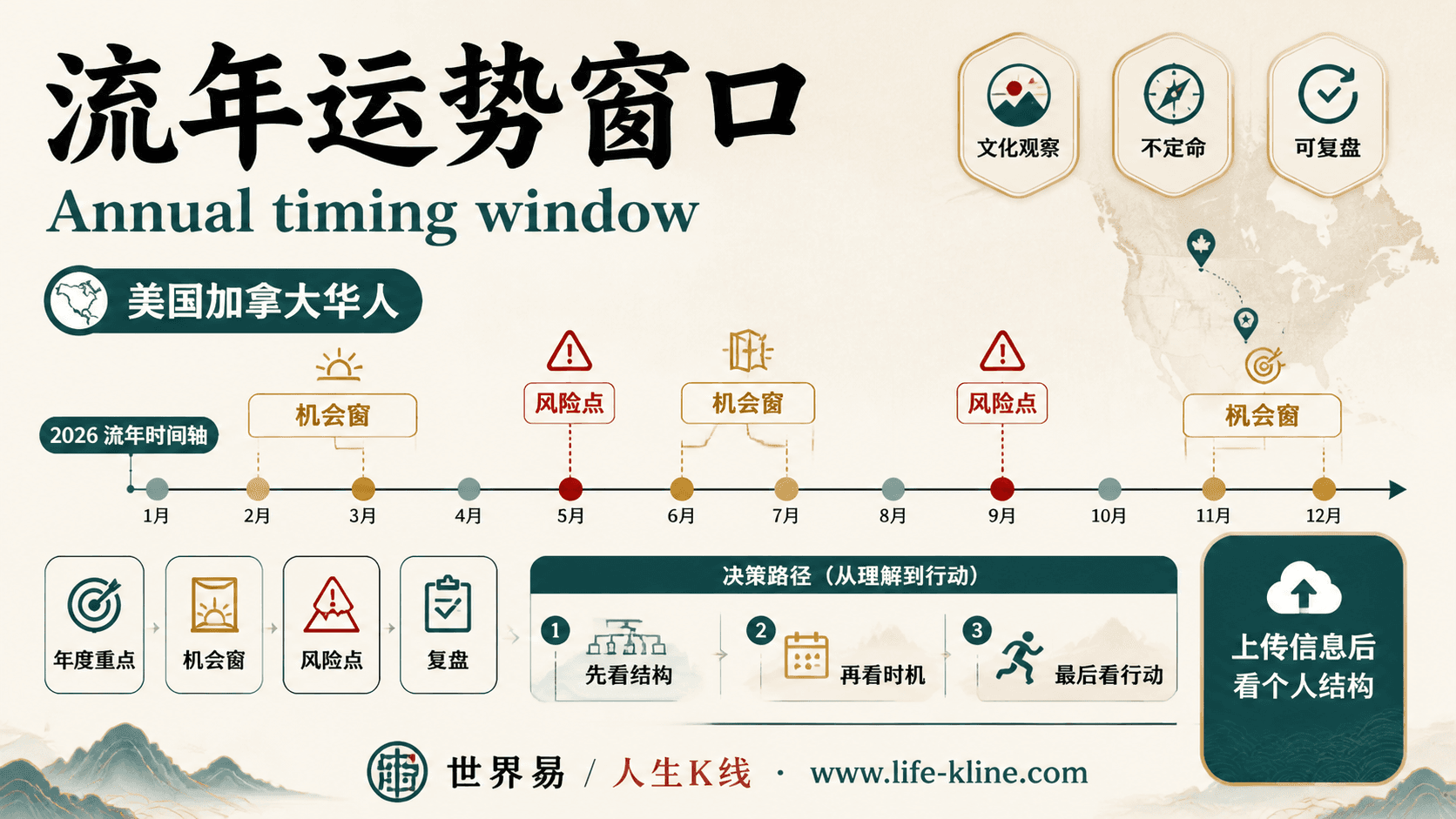
这张图把《Analysis of the Best Timing for Family Communication When Adult Children Delay Independence and Metaphysical Guidance》里的命理概念转成关系、边界和应用场景,适合先看图建立结构,再回到知识文章正文理解细节。
八字第一份报告怎么看不应被写成固定结论。更适合美国加拿大华人的读法,是把传统术语翻译成结构、时机、环境、行动和复盘。
查看图片解读